Individual Device Testing
The technician activates each initiating and notification device, then confirms that the panel identifies the correct signal and zone.
At Phoenix Fire Alarm Systems, a fire alarm inspection is a documented, code-driven process that tests the control panel, every connected device, wiring, signal transmission, and backup power. The inspection matters because each component must respond correctly during an emergency, and the completed report records deficiencies that need correction under Phoenix requirements.
The technician activates each initiating and notification device, then confirms that the panel identifies the correct signal and zone.
Circuits are checked for opens, shorts, and grounds; batteries are load-tested; and alarm, trouble, and supervisory signals are verified at the panel and monitoring center.
Device-by-device results, failed components, and required corrective actions are recorded so the building has a clear maintenance and compliance record.
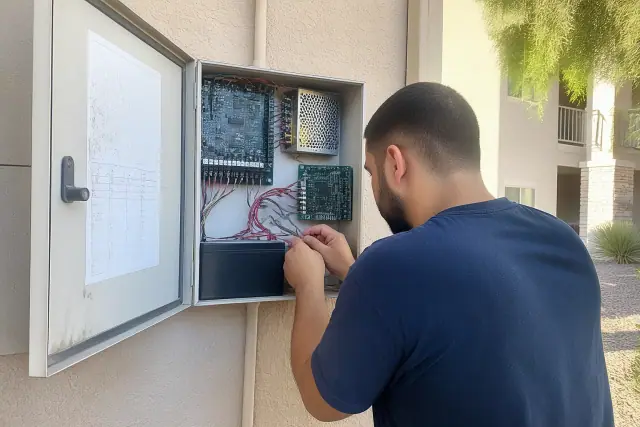
The technician verifying alarm, trouble, and supervisory signals while the panel display identifies each event correctly.
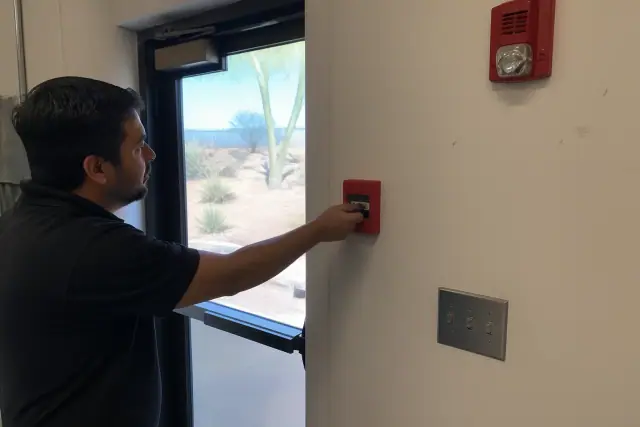
Calibrated detector testing alongside horn audibility and strobe visibility checks. These devices must be evaluated individually, not only from the panel.
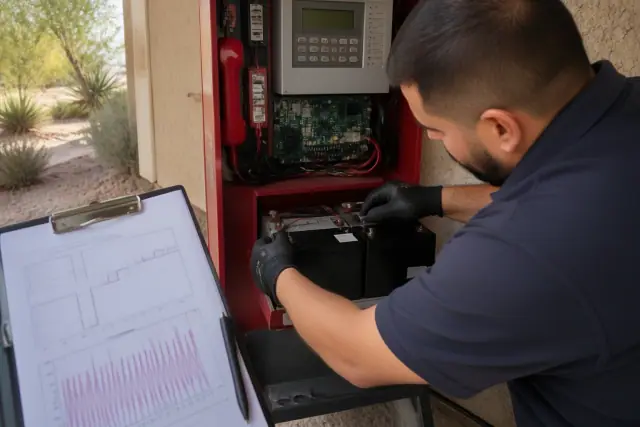
Backup batteries under load beside a device-level report with clearly marked results and deficiencies.
A small office or retail system usually takes 2-3 hours, while a standard small-to-mid commercial inspection may span 2-4 hours. Mid-size buildings often take about half a day, and facilities with hundreds of devices can take a full day or multiple visits.
Device count is the main pricing factor: a building with around 50 devices typically runs $500-$1,000 annually, medium facilities run $1,000-$3,500, and properties with 500 or more devices often run $7,000-$8,000 or higher. Larger systems with extensive smoke detector counts commonly use per-device pricing near $2.50-$3.
Most commercial systems are inspected annually, with semi-annual maintenance or quarterly testing for certain components. Some jurisdictions also require biennial testing for specific suppression-integrated devices, so the schedule depends on occupancy and system configuration.
Typical findings include low-battery detection failures, monsoon-humidity corrosion, dust-fouled warehouse detectors, unresolved trouble signals, and older 1990s-era wiring. Panels nearing the typical 10-15 year commercial service life can also show more deficiencies.
| Inspection stage | What gets tested | What the report confirms |
|---|---|---|
| Panel and power | Alarm, trouble, and supervisory signals; annunciators, LEDs, and backup batteries under load | Events display, time-stamp, and transmit correctly, with usable backup power |
| Initiating devices | Each pull station, smoke detector, and heat detector is activated individually | The panel receives the signal and identifies the correct zone or device |
| Notification appliances | Horns, strobes, and voice evacuation zones where installed | Audibility, visibility, candela setting, and message clarity meet the system design |
| Circuits and interfaces | Wiring for opens, shorts, and grounds; door releases and suppression-system signals | Connected life-safety functions respond correctly when an alarm activates |
| Documentation | Device-by-device results, deficiencies, and needed corrective action | A written inspection record is available for ongoing maintenance and fire marshal review |
Before testing begins, the technician reviews prior reports and panel programming, notifies the monitoring center, and coordinates access with property management. The on-site work combines a visual walkthrough with functional testing of the panel, detectors, pull stations, horns, strobes, batteries, circuits, fire-door releases, and suppression-system interfaces. Testing follows NFPA 72 and Phoenix Fire Code requirements, and Arizona technicians performing the work must carry the appropriate contractor licensing.
Device count, building access, occupancy, and system complexity determine how long testing takes and what it costs. Voice evacuation and mass notification systems require each zone to be checked for intelligibility and message clarity, while multi-tenant properties may need added scheduling and unit access. Integrated sprinkler waterflow switches, kitchen hood systems, generators, and fire-door controls add further functional checks when present.
To prepare, clear access to the panel and devices, provide prior reports, and notify tenants of the testing date. If the system fails, the report identifies the deficiency and corrective action; simple battery or detector issues may be resolved during the visit, while failed circuits or aging panels can require repair or replacement. Multi-family buildings follow the same core device-level process but place added emphasis on sleeping-area notification, common-area coverage, and coordinated unit access.
Share the property type, approximate device count, and any prior inspection records to receive a scope and quote based on the system's actual complexity.