Proudly serving Phoenix, Mesa, Glendale, Scottsdale, Tempe, Chandler & surrounding areasCall or Text 24/7: 602-449-8143
Aerial view of residential neighborhoods, desert washes, and low-rise buildings in Phoenix, AZ.

Fire Alarm Maintenance: Battery Testing, Device Cleaning & Sensitivity Checks in Phoenix, AZ

Phoenix Fire Alarm Systems provides fire alarm maintenance for commercial buildings in Phoenix, Arizona. Our service covers device cleaning, battery testing and replacement, smoke-detector sensitivity checks, panel diagnostics, and verification of monitoring communication paths. We also handle system inspection and testing, troubleshooting and repair, panel service, installation, monitoring, design, and upgrades. Our technicians work with addressable and conventional platforms from major manufacturers and follow NFPA 72 plus local fire and life safety requirements.

Phoenix heat, including 115-degree afternoons, can stress fire alarm panels, detectors, wiring, and backup power. Fine dust from dry weather and monsoon season can settle inside detector chambers, leading to nuisance alarms or reduced sensitivity. Deferred cleaning, weak batteries, and unresolved trouble signals can turn a minor issue into a failed annual test. A scheduled maintenance program helps keep the system functional, documented, and ready for inspection.

We track device history, battery replacement cycles, sensitivity readings, deficiencies, and inspection due dates so each visit builds on the last. If a system is failing tests or its service history is unclear, we can walk the building and define the maintenance work it needs.

Phoenix Fire Alarm Systems provides fire alarm maintenance throughout Phoenix, Scottsdale, Tempe, Mesa, Chandler, Glendale, and surrounding Maricopa County communities.

★ ★ ★ ★ ★4.9/5 Average Rating · 20+ Years of Experience · Thousands of Customers Helped · Licensed & Insured · Residential & Commercial

Fire Alarm Maintenance Options & Benefits

What Is Fire Alarm Maintenance?

Fire alarm maintenance is the ongoing cleaning, testing, adjustment, and repair work that keeps a system functional between formal inspections. It is distinct from the documented inspection that verifies each device and system function, but the two activities support the same compliance and reliability goals.

A maintenance visit can include smoke-detector sensitivity checks, device cleaning, battery voltage testing, panel diagnostics, and verification that alarm, trouble, and supervisory signals reach the monitoring center. The exact schedule depends on the occupancy, system condition, device history, and requirements set by the Authority Having Jurisdiction.

Annual bundled maintenance packages typically run $500 to $2,000 depending on system size and device count, often with routine inspection work included. Smoke detectors have a service life of about 10 years before replacement is required even when they have been maintained. A written scope should identify included visits, testing, documentation, and corrective work.

Benefits of Scheduled Fire Alarm Maintenance

Scheduled maintenance addresses developing faults before they compromise a test, trigger avoidable dispatches, or leave a building without dependable coverage. A consistent program also gives owners and managers a clear record of system condition over time.

  • Cleaner detector chambers with fewer dust-related nuisance alarms
  • Tested batteries and dependable panel backup power
  • Sensitivity readings that identify drifting smoke detectors
  • Verified alarm, trouble, and supervisory communication paths
  • Audibility and visibility checks for horns, strobes, and speakers
  • Device-level records for the fire department or insurance carrier
  • Earlier identification of wiring faults, obsolete parts, and placement gaps
  • Tracked battery cycles, deficiencies, and future inspection due dates
Maintenance Services

Phoenix Fire Alarm Maintenance Services

A complete maintenance program covers initiating devices, notification appliances, the fire alarm control panel, backup power, monitoring connections, and the records tying those components together. We tailor the work to the building, occupancy, system platform, and documented service history.

Detector Cleaning & Sensitivity Checks

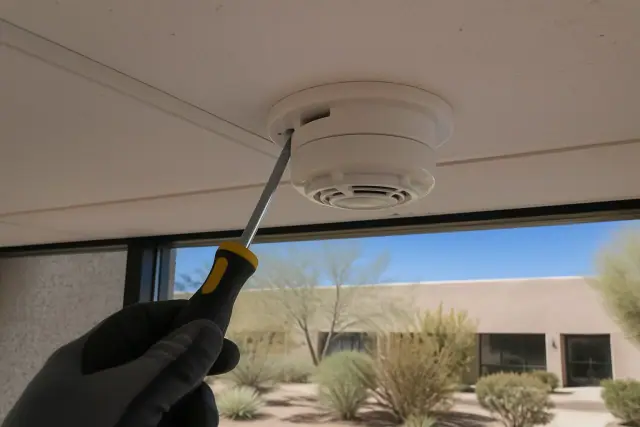
Technician installing a smoke detector on a commercial ceiling at a job site in Phoenix, AZ.

Fine Sonoran Desert dust can collect inside smoke-detector sensing chambers and contribute to false alarms or reduced sensitivity. We clean accessible devices, check detector response and sensitivity, and flag units that have reached the end of their service life.

Request Estimate

Battery Testing and Replacement

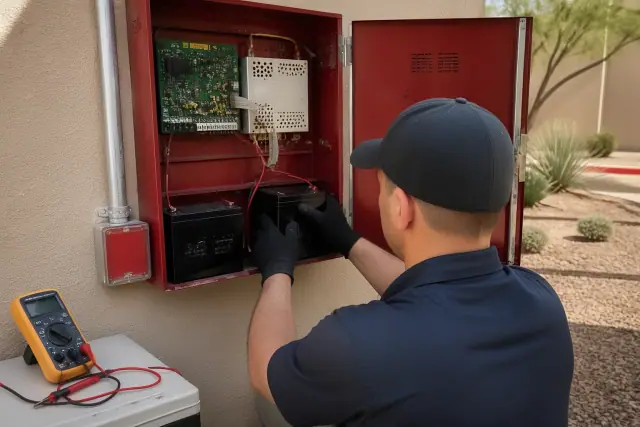
Technician replacing backup batteries in a fire alarm control panel at a commercial building in Phoenix, AZ.

Backup batteries are tested for condition and voltage, then replaced when age or performance indicates they can no longer support the panel standby load. Replacement dates are recorded so weak batteries do not become a recurring trouble signal.

Request Estimate

Panel Diagnostics and Trouble Review

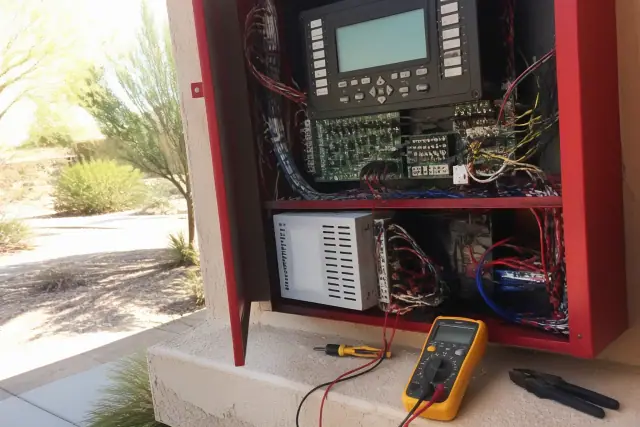
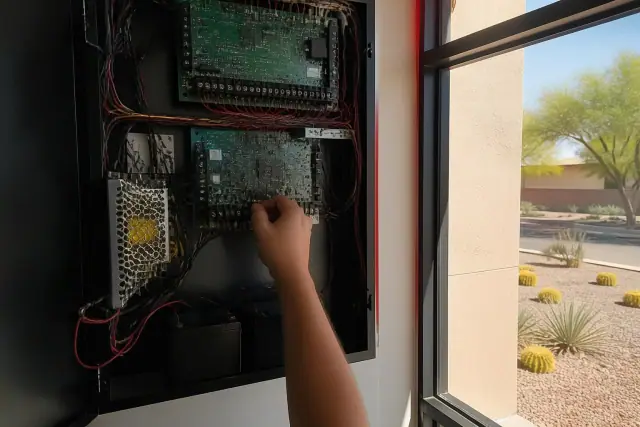
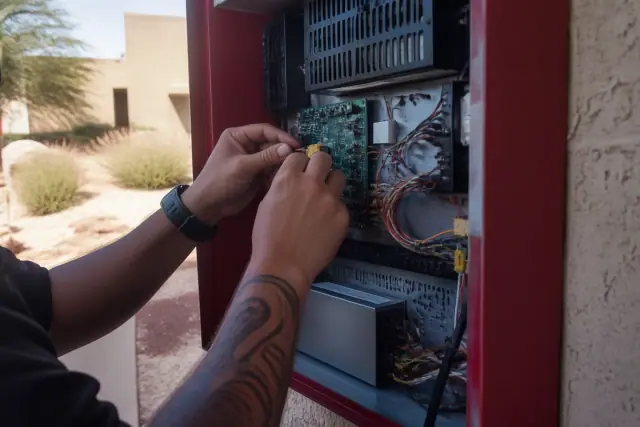
Technician hands working on a fire alarm control panel with complex wiring in Phoenix, AZ.

Panel diagnostics reveal ground faults, open circuits, zone faults, and recurring trouble or supervisory events. We review panel history, trace the affected circuit or device, and determine whether cleaning, repair, programming, or replacement is appropriate.

Request Estimate

Monitoring Path Verification

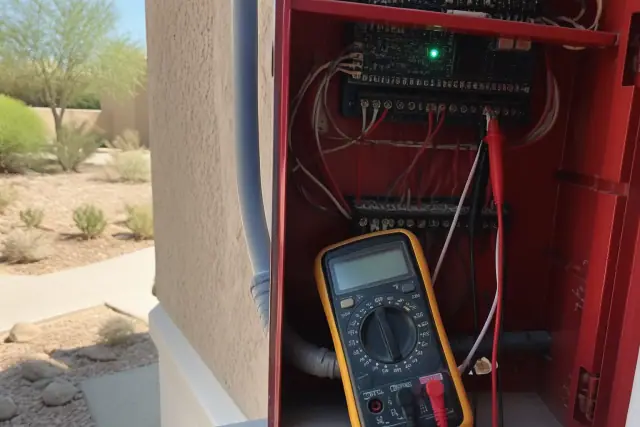
Multimeter testing fire alarm wiring on a stucco wall during maintenance in Phoenix, AZ.

For monitored systems, we verify that alarm, trouble, and supervisory signals travel through the configured cellular or phone communication path to the UL-listed central station. Reliable communication is essential when a building is empty and no one is present to hear a local alarm.

Request Estimate

Notification Appliance Testing

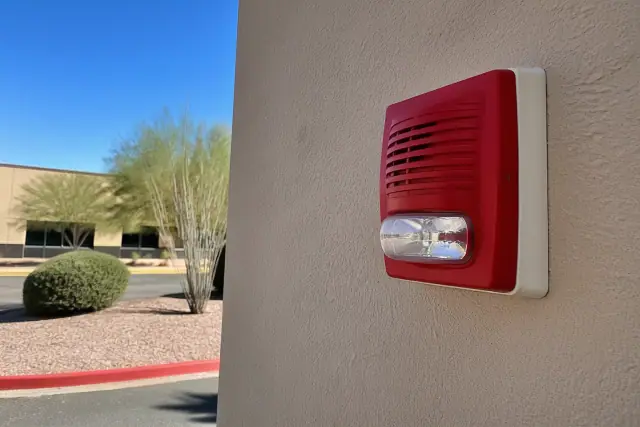
Wall-mounted fire alarm horn-strobe device on a stucco building exterior in Phoenix, AZ.

Horns, strobes, and speakers must still provide the required audible and visible notification throughout the building. We test device operation and confirm that the panel annunciates the correct zones while integrated systems follow the intended sequence of operations.

Request Estimate

Maintenance Records and Scheduling

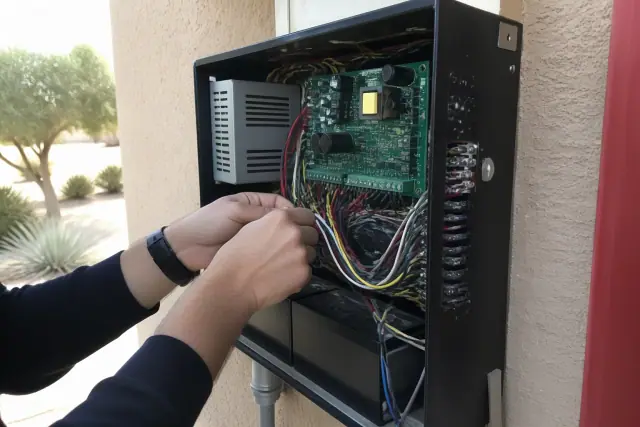
Technician wiring a fire alarm control panel cabinet with multicolored circuits in Phoenix, AZ.

Each visit is documented with device history, battery voltage, sensitivity readings, deficiencies found, and corrections completed. We also track inspection due dates and upcoming maintenance needs so records are ready for the Authority Having Jurisdiction or insurance carrier.

Request Estimate
Supported System Types

Fire Alarm Systems We Maintain

Maintenance needs change with panel architecture, building size, notification method, and the number of integrated safety functions. Our technicians work with addressable and conventional panels as well as voice evacuation, mass notification, and coordinated building-safety interfaces.

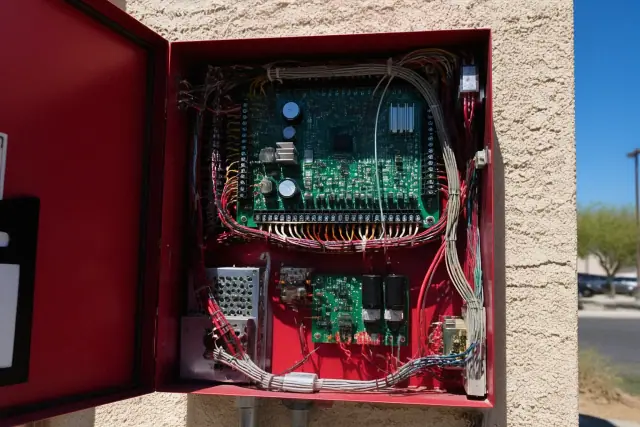
Interior of an addressable fire alarm control panel with complex wiring on a stucco wall in Phoenix, AZ.

Addressable Fire Alarm Systems

Addressable platforms identify individual devices at the panel, helping technicians isolate a detector, pull station, or module that needs attention. They are well suited to larger properties where point-level information and expansion capacity simplify ongoing service.

  • Point-level detector and pull-station identification
  • Networked configurations supporting hundreds of devices
  • Remote diagnostic access on compatible panels
  • Trouble and supervisory history review
  • Capacity checks for planned building expansion
Request Estimate
Technician wiring a fire alarm control panel cabinet in Phoenix, AZ.

Conventional Fire Alarm Systems

Conventional systems group devices into zones rather than reporting an individual device address. They can be practical for smaller, simpler occupancies, but their supervised circuits, backup power, devices, and monitoring path still require methodical service.

  • Zone-based alarm annunciation
  • Supervised circuit checks
  • Backup power and standby-load review
  • Conventional detector and pull-station testing
  • Monitoring communication verification
Request Estimate
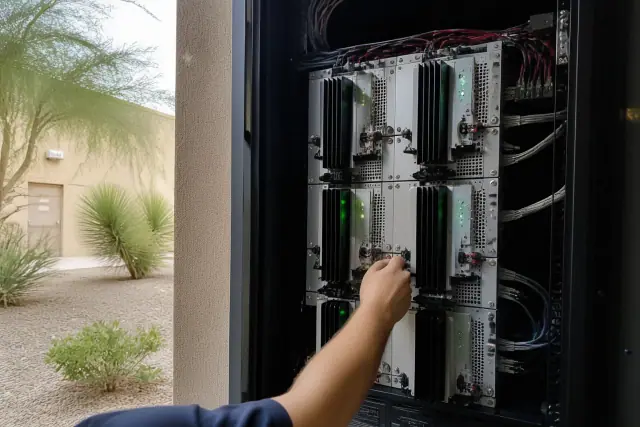
Technician inspecting modular voice evacuation system amplifiers in a Phoenix, AZ server rack.

Voice Evacuation Systems

Voice evacuation systems replace a simple alarm tone with prerecorded or live instructions for occupants. Maintenance must confirm that the panel, speakers, programming, and alarm-event sequence deliver clear, code-compliant messages.

  • Prerecorded and live evacuation instructions
  • Speaker audibility and intelligibility checks
  • Panel programming review
  • Alarm-event message sequencing
  • Support for high-rises, assembly venues, and larger occupancies
Request Estimate
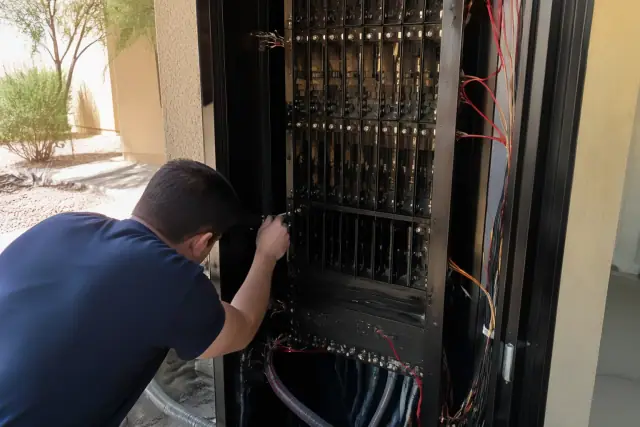
Technician inspecting mass notification system wiring inside a server rack at a building in Phoenix, AZ.

Mass Notification Systems

Mass notification systems extend emergency messaging beyond fire events and can coordinate panel signals with text, email, or PA broadcasts. Their maintenance plan should verify the configured channels and how messages move through the system.

  • Fire, severe-weather, and security notifications
  • Text, email, or PA broadcast support
  • Fire alarm panel integration
  • Multi-channel sequence verification
  • Applications in schools, government buildings, and large campuses
Request Estimate
Technician wiring a fire alarm control panel in Phoenix, AZ, with desert landscaping visible in the background.

Integrated Building Safety Systems

A commercial fire alarm may control or monitor other life-safety functions throughout the property. Maintenance should test the full sequence of operations so the system response is coordinated rather than checking alarm devices in isolation.

  • Elevator recall interfaces
  • HVAC shutdown commands
  • Magnetic door-holder release
  • Sprinkler waterflow signals
  • Full sequence-of-operations testing
Request Estimate
A Plan for Your Building

Choosing the Right Maintenance Approach

The right approach depends on occupancy classification, ceiling height, airflow, hazard areas, system age, device count, monitoring path, and prior deficiencies. A small retail tenant space may need a different service rhythm than a medical office, warehouse, high-rise, or assembly venue. When an obsolete panel, unavailable parts, repeated failures, or an addition makes maintenance alone impractical, a phased upgrade or replacement may be the better path.

NFPA 72 and Local-Code Focus

Inspection, testing, repair, design, and service follow NFPA 72 together with the fire and life safety requirements enforced by the City of Phoenix Fire Department and Maricopa County. Phoenix Fire Alarm Systems holds the Arizona licensing required for fire alarm design, installation, and service, and its technicians are trained on major panel platforms.

Phoenix Operating-Condition Experience

Phoenix systems operate through extreme heat, fine desert dust, monsoon conditions, and large temperature swings. Our maintenance planning accounts for how those conditions affect detector chambers, wiring, panels, and backup power across retail, office, warehouse, healthcare, high-rise, and assembly properties.

Device-Level Documentation

We record battery voltage, smoke-detector sensitivity, device history, deficiencies, corrections, and upcoming due dates. That device-level paper trail helps owners answer questions from the fire marshal, Phoenix Fire Plan Review, the Authority Having Jurisdiction, or an insurance underwriter.

What Sets Our Work Apart

Why Choose Us for Fire Alarm Maintenance?

We treat maintenance as a continuing program instead of an isolated visit. The work connects device condition, panel history, monitoring communication, integrated building functions, corrective repairs, and compliance documentation so owners can see what was tested, what changed, and what should happen next.

Request Maintenance Assessment

Dust-Contaminated Detectors

Fine dust can settle in detector chambers during dry weather and monsoon season. Contaminated devices may create nuisance alarms or become less responsive, making cleaning and sensitivity checks an important part of Phoenix fire alarm maintenance.

Ground Faults and Open Circuits

Ground faults and open circuits can produce persistent trouble lights, intermittent chirping, or zone faults at the panel. Tracing the affected pathway early helps prevent a localized wiring issue from developing into broader system trouble.

Weak or Dead Batteries

A battery that was never tested or replaced is a common cause of avoidable trouble calls, including the disruptive 2 a.m. alert. Voltage testing, standby-power review, and recorded replacement cycles make battery condition predictable instead of reactive.

Recurring False Alarms

False alarms disrupt tenants and operations and may lead to response fees or municipal fines for repeat incidents. Detector cleaning, accurate programming, dependable monitoring paths, and verification protocols help address the conditions that cause false dispatches.

Obsolete Panels and Scarce Parts

A panel may be a poor candidate for continued repair when the manufacturer no longer supports it, parts are unavailable, or a building addition exceeds its device capacity. Repeated trouble signals, false alarms, and failed tests can also indicate that an upgrade is more practical than another patch.

Failed Tests and Missing Records

Missed maintenance cycles are a common reason systems fail annual testing. In older office conversions and retrofitted warehouses, renovations may also leave as-built drawings or detector placement out of step with current walls, requiring documented corrections before the next evaluation.

How Maintenance Works

Our Fire Alarm Maintenance Process

Our process starts with the existing system, occupancy, records, and current trouble history, then moves through device service, panel diagnostics, notification and communication checks, corrections, and documentation. The result is a maintenance record and follow-up schedule tied to the actual building rather than a generic checklist.

01.

Review System History and Occupancy

We review the panel platform, occupancy classification, device inventory, monitoring connection, past inspection reports, service history, and known deficiencies. A building walk also helps identify renovations, hazard areas, airflow, and access conditions that affect testing and detector placement.

02.

Clean and Test Initiating Devices

Smoke detectors, heat detectors, duct detectors, pull stations, and related initiating devices are cleaned and tested as appropriate. We record sensitivity or response findings and identify devices that need adjustment, repair, or replacement.

03.

Check the Panel and Backup Power

We review panel status and history for ground faults, open circuits, zone issues, trouble events, and supervisory signals. Backup batteries are tested for voltage and condition against the system standby-power needs.

04.

Verify Notification and Communication Paths

Horns, strobes, and speakers are checked for operation, audibility, visibility, and correct annunciation. We also verify monitoring communication and the programmed response of elevator recall, HVAC shutdown, door holders, sprinkler waterflow, and other connected functions.

05.

Correct and Document Deficiencies

Deficiencies are identified at the device or circuit level, and completed cleaning, adjustment, repair, or replacement is recorded. When permitted design work or plan review is needed, that requirement is separated from routine maintenance so the owner understands the next step.

06.

Set the Next Maintenance Schedule

The completed record lists work performed, readings, deficiencies, corrections, and remaining recommendations. We then track battery replacement cycles, future maintenance needs, and inspection due dates according to the building and Authority Having Jurisdiction requirements.

Keep Your System Ready

Schedule Fire Alarm Maintenance Service

If your fire alarm has a persistent trouble signal, recurring false alarms, failed-test deficiencies, or an unclear service history, request a maintenance assessment. Phoenix Fire Alarm Systems will review the building and system so you receive a defined scope for cleaning, testing, repairs, documentation, and ongoing scheduling.

Maintenance Help

Fire Alarm Maintenance FAQs

These answers cover service intervals, smoke-alarm care, maintenance costs, inspection requirements, monitoring, system outages, and records for Phoenix commercial fire alarm systems. For a building-specific plan, the system type, occupancy, device history, and local requirements all need to be reviewed together.

Call About Maintenance

Smoke alarms should be vacuumed to clear dust from the sensing chamber, especially during Phoenix dry weather and monsoon season. Batteries should be tested monthly and replaced at least annually, or immediately when a low-battery chirp begins. The entire smoke alarm should be replaced after about 10 years because its sensing components degrade with age.

Full inspection and testing is required annually at minimum under NFPA 72. Some components may need semi-annual checks, while high-risk occupancies such as healthcare facilities, high-rises, and assembly spaces may benefit from monthly or quarterly attention based on the Authority Having Jurisdiction. The maintenance schedule should match the occupancy, system condition, and device history.

Maintenance can include detector cleaning, battery testing and replacement, sensitivity checks, panel diagnostics, monitoring-path verification, and notification-appliance checks. It should also review alarm, trouble, and supervisory history so developing faults are addressed before a formal inspection. Every visit should document readings, deficiencies, and completed corrections.

Annual bundled maintenance packages typically run $500 to $2,000 depending on system complexity and device count, often with routine inspection work included. Monthly monitoring fees generally range from $25 to $100 depending on service level and whether the connection is cellular or a traditional phone line. A written scope should explain what the quoted amount covers.

Inspection and testing is the formal verification that devices and system functions operate correctly, with results recorded on the appropriate NFPA 72 documentation. Maintenance is the ongoing cleaning, battery work, diagnostics, adjustment, and repair performed between those formal tests. One does not replace the other, though both can be organized under one service program.

Yes. Arizona requires fire alarm design, installation, and service work to be performed by a licensed contractor, and permitted work in Phoenix must be tied to a licensed entity for plan approval. Phoenix Fire Alarm Systems holds the required Arizona licensing and manufacturer certifications for the equipment it installs and services.

The inspection produces a deficiency list with a correction timeframe set by the inspector or Authority Having Jurisdiction, often 30 days for non-critical items. Critical faults or a fully impaired system require faster action, and an interim fire watch may be necessary until coverage is restored. Corrected items should be documented for the follow-up review.

Fine particulate dust from the Sonoran Desert can settle inside a detector sensing chamber. That contamination may cause nuisance alarms or reduce sensitivity, especially when cleaning is deferred through dry months and monsoon season. Regular cleaning and sensitivity checks help reveal whether a detector can remain in service.

Under NFPA 72, a system outage lasting more than 4 hours requires restoration or a fire watch. A fire watch uses staffed personnel to patrol the building until dependable alarm coverage returns. Prompt troubleshooting of panel, circuit, battery, and communication faults can limit that disruption.

Addressable systems report the specific device involved and are often used in larger properties that need point-level identification. Conventional systems group devices by zone and can suit smaller, simpler occupancies. Both require supervised-circuit checks, backup-power review, device testing, and dependable monitoring communication where connected.

No. 24/7 monitoring connects the panel to a UL-listed central station that receives alarm, trouble, and supervisory signals when the building is occupied or empty. Maintenance keeps the devices, panel, batteries, and communication path working so those signals can be sent reliably.

Replacement may be appropriate when a panel is obsolete, manufacturer support has ended, parts are unavailable, repeated tests fail, or an addition exceeds device capacity. A new installation can take from a few days for a small tenant space up to several weeks for a multi-floor commercial build-out. Phased cutover and commissioning help limit downtime before final sign-off.

The record should identify devices or circuits serviced, battery voltage, sensitivity readings, deficiencies, and corrections. Formal testing should also produce the applicable NFPA 72 Record of Completion and Inspection and Testing Form documentation. Keep those records available for the Authority Having Jurisdiction, fire department, and insurance underwriter.